

Our Services
Early-Life Device Stability Diagnostics
Modern devices often fail after they pass electrical specs.
Mcap-Labs testing and reliablity engineers help teams detect instability while it is forming, using LockScore™ — a quantitative stability metric that reveals hidden failure risk early.
✅ LockScore™enables teams to:
Detect emerging instability or drift before it affects scale outcomes
Compare test groups, process splits, or design variants with confidence
Reduce uncertainty during early production, pilot builds, and rollouts
Inform go/no-go decisions with quantitative signals, not guesswork
Connect early test behavior to downstream reliability outcomes
What Is ✅ LockScore™
A single stability signal. Early. Actionable.
✅ LockScore™ is a scalar stability score derived from the structure, repeatability, and evolution of early-life electrical or electrochemical response data.
It classifies devices as:
🟢 Stable — safe to scale or ship
🟡 Marginal — monitor or bin conservatively
🔴 Unstable — early-life failure risk
✅ LockScore™ appears from existing data — often after far fewer test cycles than traditional methods require.
How It Works
Designed for low friction early manufacturing insight
You share existing test data
Electrical characterization, formation curves, stability tests, or other early diagnostic measurements.We compute ✅ LockScore™
Analyze structure, repeatability, and coherence of the data to extract early-life risk signals.You receive a stability classification report
🟢 Stable — safe to scale, assemble, or ship
🟡 Marginal — monitor or bin conservatively
🔴 Unstable — early-life failure risk
✅ LockScore™ appears from existing data — often after far fewer test cycles, long before endurance, burn-in, or system-level failures.
No hardware.
No fab disruption.
No IP exposure.
Applicable Domains
This approach applies wherever early-life stability or latent risk manifests in measurable test behavior, including:
Semiconductor devices & memory technologies (e.g., ReRAM, PCM)
Battery systems and cells (formation curves, cycling stability)
Power and analog components
Manufactured assemblies with reliability constraints
Whether your concern is electrical drift, capacity fade, thermal variability, or consistency loss, we provide the signal before you scale.
One Reason ✅ LockScore™ Matters
Failure rarely begins as a spec violation.
It begins as unstable internal switching behavior.
Traditional tests answer:
“Does it pass today?”
✅ LockScore™ answers:
“Is this device forming stably — or already drifting toward failure?”
That earlier distinction is why LockScore matters.
The Big! Reason for
✅ LockScore™
Early-life instability often leads to late scrap, excess burn-in, and conservative margins.
In advanced semiconductor programs, even a 0.5–2% improvement in yield or earlier scrap decisions can unlockmillions ($) of dollars per yearin recovered value — without any process changes.
Join Our Pilot Program
Curious whether early test data already contains a meaningful reliability signal?
Our paid pilot uses your prior data to validate whether LockScore™ and related analytics can inform your future decisions.
Talk to usabout how ✅ LockScore™ can complement your reliability & yield strategy.
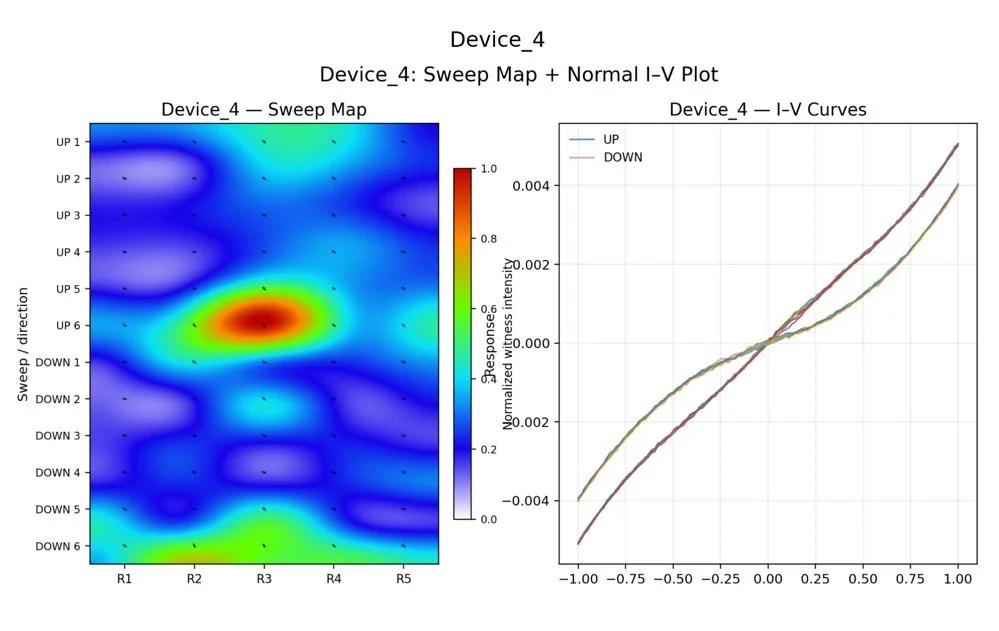
Get Early Instability Scan - Identify a few devices that show instability — even when early sweeps still look normal.
1. Upload I–V sweep data (10–20 devices)
2. We analyze structural instability patterns
3. You receive diagnostic report and GO / HOLD / NO-GO classifications in 48–72 hours
Devices that look identical early don’t always behave the same later.